














Skip to content

Enterprise loyalty platform for Latin America: what it takes to run one program across countries

Resources · Guide

The enterprise loyalty platforms most evaluated in Latin America are regional ones, such as Qurable, Leal, and Spoonity, and global ones, such as Comarch, Open Loyalty, Antavo, Capillary, and Talon.One. To run one program across several countries, the platform has to operate from a single base with each market's currency, taxes, payment methods, language, and rules, with enterprise scale and security. Qurable runs loyalty programs for large and mid-sized companies in more than 6 Latin American markets.

Updated · 13 min read

  • 18MMembers on QurableTotal managed on the platform today
  • < 50 msMember recognized at checkoutp95, measured server-side
  • 1–3Months to go liveWith your current program or from scratch
  • 99.5%AvailabilityMonthly SLA · ISO 27001

Key takeaways

  1. The platforms most evaluated in LATAM are regional (Qurable, Leal, Spoonity) and global (Comarch, Open Loyalty, Antavo, Capillary, Talon.One).
  2. Copying the program country by country leaves each market with its own system and balance.
  3. Fuel, restaurant, airline, retail, and fintech brands run their programs on Qurable in more than 6 Latin American markets.

Direct answers

Build or buy an enterprise loyalty platform?

Building means designing the points ledger, liability, expirations, fraud controls, and integrations, and then maintaining them. Buying an API-first platform like Qurable gets a program into production in 1–3 months, with those pieces already running at scale.

BuildBuy (API-first)
Ledger and liabilityTo design and auditBuilt in, double-entry
Time to launchUsually a year or more1–3 months for the pilot
Payments integrationTo build per processorAlready live with clients
MaintenanceYour teamThe platform

What should an enterprise loyalty platform have?

Several countries and currencies in one program, rewards applied at payment, a ledger that treats points as money, certified security, and open APIs. Qurable covers all five and is ISO 27001 certified.

Loyalty RFP checklist

Full version · PDF report

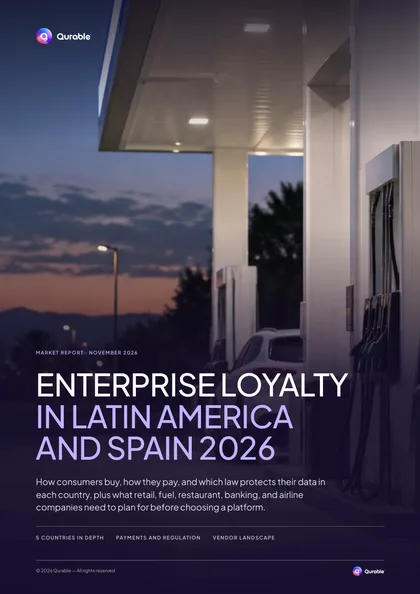
Enterprise loyalty in Latin America and Spain 2026

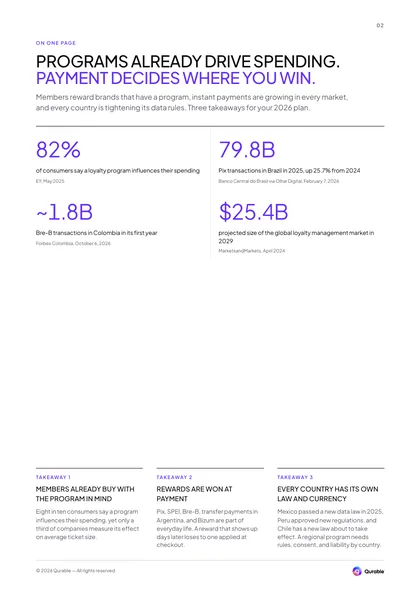
This page is the summary. The full report covers how consumers behave, how they pay, and what the law requires in each market, with one page per country and the questions to ask in your next evaluation.

18
pages
7
markets compared
26
sources
14
evaluation questions

Only in the PDF

  • A country-by-country matrix of payments, data laws, and program names
  • One page per country: Argentina, Chile, Mexico, Colombia, and Spain
  • Payment and regulatory changes from 2024 to 2026, on one timeline
PDF · Free

The options

Which loyalty platforms lead in Latin America?

For enterprise programs across several countries, companies evaluate regional platforms such as Qurable, Leal, and Spoonity; global ones such as Comarch, Open Loyalty, Antavo, Capillary, and Talon.One; and the loyalty modules of CRM suites. The difference comes down to local operations, currencies, and each country's payment methods.

Types of loyalty platforms evaluated in Latin America and what to ask each one
PlatformsWhat to ask them
RegionalQurable, Leal, Spoonity, Superlikers, FieloNamed clients in your country, several currencies in one program, and local payments in production
Global, operating in the regionComarch, Open Loyalty, Antavo, Capillary, Talon.One, Loyal GuruWho handles implementation and support in the region, in which language and hours, and which local payment methods are already integrated
Loyalty modules of CRM or marketing suitesSalesforce Loyalty Management, SAP Emarsys, OracleWhether the points ledger and liability come built in or must be built, and how the reward is decided at payment
Tools for small merchantsStamp and points apps for one or a few storesWhether it supports several brands, several countries, and enterprise scale

An indicative list, in no particular order, built from the platforms that most often appear in evaluations in the region.

The difference

A platform built for one country or one built for the region.

Many loyalty programs start in one country and get copied into the next. That works until you add currencies, partners, and local teams. Then every country ends up with its own system, its own balance, and its own report.

A loyalty platform built for one country compared with one built to run across Latin America
Built for one countryBuilt for Latin America
CurrenciesOne currency; everything else converted by hand in reportsEach country in its own currency, with point value and liability calculated in it
RulesThe same rules everywhere, or a separate instance per countryOne program with each country's own rules, expirations, and rewards
Payments and taxesOne processor and one tax treatmentEach market's payment methods, wallets, and tax criteria
Language and namingOne copy for every memberCommunication in each country's language, under the local program name
IntegrationsA new project for every local POS, ecommerce platform, or partnerConnectors already proven with the systems used in the region
Finance viewA consolidation built at month-endLiability by currency, country, and store, visible at any time

Requirements

What a regional platform has to handle.

Seven areas separate a platform that works in one country from one that can carry a program across Latin America. Use them to evaluate any vendor.

RequirementWhat a good answer looks like
Does it run several currencies at once?Balances, point value, and redemptions in each country's currency, with no manual conversions.
How does it report loyalty points liability?Split by currency and country, with projected expirations, so each subsidiary can reconcile it with its own books.
Does it support several programs or program currencies?Points, cashback, or other currencies, each with its own rules and its own issuance control.
Does it connect to each country's payment methods?Cards, digital wallets, and local processors, with the reward applied inside the payment, not afterward.
How does it handle tax on rewards?The discount or redemption recorded with the detail each country's invoice needs. Your tax team decides the treatment.
How does it handle returns?Full and partial reversals that return or deduct the points from the original purchase.
Does it speak each member's language?Spanish, Portuguese, and English across the app, emails, and messages, by country and by member.
Does it respect the local program name?“Club de beneficios” in Argentina, “programa de beneficios” in Chile, “programa de lealtad” in Mexico: one engine, each market's vocabulary.
Which regional systems is it already connected to?POS, ecommerce, wallets, CRM, and messaging used in Latin America, live with real customers, not just listed in a catalog.
How does a local partner join?Through an API, coupons or QR codes, without a new integration project for each merchant.
Where is each country's data stored?Cloud and region options that meet each market's personal data rules.
How does it manage consent?Consent per channel, with date and source, and deletion of personal data with an audit trail.
What volume does it handle in production today?Members, transactions per second and peaks measured in live customer programs, not lab estimates.
What happens to the sale if the platform is down?The sale is never blocked in any country: earning is queued and recorded when service returns.
Which certifications and SLA does it have today?Certificates with their scope and date, and an explicit monthly SLA.
Who runs the program in each country?Permissions by role and organization, so each subsidiary runs its own and headquarters sees the consolidated view.
What hours and languages does support cover?Support across your markets' time zones and languages, with contractual service levels.

Country by country

One program, in each market's vocabulary.

You can run one engine, but the program name, currency, and payment methods change from country to country. These common differences are worth planning for from day one.

  • Argentina

    “Club de beneficios”

    Members expect instant discounts and digital wallet payments. With prices moving fast, point value needs frequent review.

    Plan for
    Spend-based earning rules you can adjust without development.
  • Chile

    “Programa de beneficios”

    Partnerships between airlines, banks, and retailers are common: members earn and redeem across many brands.

    Plan for
    Points exchange, with each partner's contribution recorded.
  • Mexico

    “Programa de lealtad”

    Large programs in retail, fuel, and restaurants, with demanding in-store and checkout operations.

    Plan for
    Fast identification at the POS and sales that are never blocked.
  • Colombia and Peru

    “Programa de fidelización” or “de puntos”

    Programs that coexist with co-branded credit cards and partners across several categories.

    Plan for
    Rewards inside card payments and with partners.
  • Brazil

    “Programa de fidelidade”

    A different language, currency, and set of payment methods: the market that shows whether a platform is truly regional.

    Plan for
    Portuguese copy and liability kept in reais.

How to evaluate

How to check that it's really regional.

In a pitch deck, every platform claims to run across Latin America. These tests show whether it does in production.

  • Ask for customers in several countries

    Programs live in more than one market, with references you can call.

  • Ask to see liability by currency

    A report with two countries' liability, each in its own currency, with no spreadsheets in between.

  • Ask for connected integrations

    Which POS, wallets, and ecommerce platforms in your region are already live with customers.

  • Ask for a rule per country

    Have them set up a rule for one country in the demo without touching another.

  • Separate what's live from the roadmap

    Certifications, SLA, and deployment: what exists today, kept separate from what's planned.

With Qurable

One program across countries, on one platform.

Fuel, restaurant, airline, retail, and fintech brands run their loyalty programs on Qurable in more than 6 Latin American markets.

  • Liability by currency and country

    A double-entry ledger with real-time liability by currency, country, and store, and several programs per brand, each with its own rules.

    See the points ledger
  • Integrations already live with customers

    Napse (TOTVS), VTEX, Tiendanube, Mercado Pago, MODO, Pomelo, Salesforce, WhatsApp, and more, with an API and webhooks for everything else.

    See the platform
  • In the cloud and region you choose

    Runs in containers, in Qurable's cloud or yours, on any provider and region. ISO 27001 certified, with a 99.5% monthly SLA.

    See data and security
  • A coalition in production

    SKY Plus runs on Qurable with more than 1.7 million active members, 70+ partnerships, and 50,000 daily partner transactions.

    See the SKY Plus case

FAQ

What people ask about enterprise loyalty in Latin America.

For loyalty, technology, finance, and procurement teams operating in more than one country.

It depends on size and industry. For enterprise programs across several countries, Qurable manages 18 million members with programs in production in more than 6 markets, such as Shell Box, ON by Axion Energy, MostaClub, TRIBU and SKY Plus by SKY Airline. Companies in the region also evaluate local platforms such as Leal and Spoonity, and global ones such as Comarch, Open Loyalty, Antavo, or Talon.One. To choose, ask for named clients in your country, multi-currency handling, and integration with local payment methods.

It's the software that runs a large company's loyalty program: members, earning and redemption rules, rewards, partners, and the accounting record of every point. What sets it apart from small-business tools is scale, integration with existing systems, security, uptime, and the financial control it provides.

Currency, taxes, payment methods, language, and data rules all change by country. The platform has to support country-level rules and rewards within one program, liability split by currency, and integrations with local systems, without a separate instance per market.

It varies: “club de beneficios” is common in Argentina, “programa de beneficios” in Chile, and “programa de lealtad” in Mexico; Colombia and Peru use “programa de fidelización” or “programa de puntos,” and Brazil uses “programa de fidelidade.” The concept is the same, but members respond better to the local term.

It depends on the brand. A regional program makes coalitions, consolidated reporting, and cost control easier; one per country gives more local freedom. A regional platform supports both: one engine with each country's own rules, rewards, and currencies.

With the same criteria in every country: programs running in several markets, liability shown by currency, integrations already connected to local payment methods, different rules per country, and a clear line between what's live and what's on the roadmap. Qurable runs programs in more than 6 Latin American markets.

Last reviewed

Further reading

The pages that explain each area of a regional evaluation.

Does your program run in more than one country?

In a 45-minute technical session, we'll show you how Qurable runs a regional program, with a case like yours.

Read the documentation