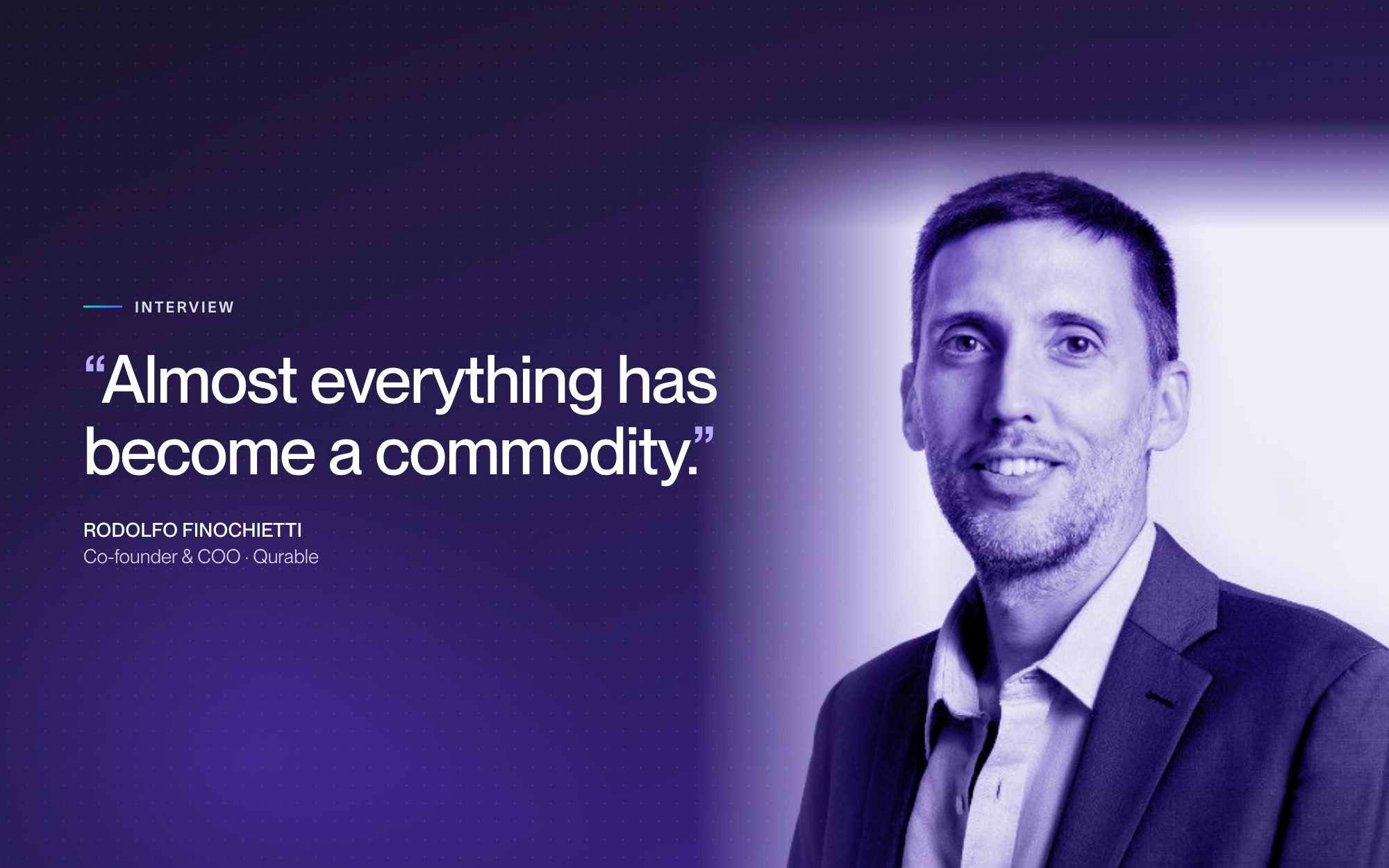

Rodolfo Finochietti describes himself as a programmer before anything else. He started very young and, over the years, held a range of roles in technology, always moving between two worlds: software development and team management. When he co-founded Qurable, operations was the natural fit for him.
Today he is COO. His job is to keep the company running and to make sure teams are distracted as little as possible from what matters: building the platform and serving customers well. Even so, he hasn't stepped away from the technical side. He still handles customer integrations, partly because he enjoys it and partly because at a startup everyone wears more than one hat.
We talked with him about what is changing in the loyalty market, what companies expect from technology today, and how you run a fast-growing company.
The bar keeps rising
Rodolfo sees the market accelerating something the founders already sensed when they started Qurable. There is more technology and more tooling than ever, and yet standing out is harder. A clothing brand, for example, no longer stands out just by making and selling good products.
Almost everything has become a commodity. You have to differentiate with a strong customer experience strategy and with loyalty done right, not as a trick to retain the user. They should stay because you genuinely give them the best service and you understand them.
That's why he believes customer experience is no longer an extra. At companies of every size and in every industry, it is becoming part of the business. And as more and more service gets automated, personalization matters more, because customers want the brand to know who they are.
The way we consume has changed too. We are more connected than ever, but we move in increasingly defined communities, and algorithms reinforce that through the music, content and products they show us.
The generic message, the generic promotion, the generic program, they breed distrust. You get offered two-for-one at a place where you've never bought anything. What does that have to do with me?
Hence the importance of knowing who your customers are, which ones are valuable and which ones are worth building loyalty with, and shaping your strategy around that.
If I can compare three quotes, why can't I understand my customers?
Companies expect more, too. Many have plenty of data but struggle to turn it into decisions. Rodolfo explains it by looking back.
In the days of Windows 95 or 98, technology failed all the time. Computers took forever to boot or froze, and if a store told you the system was down, nobody was surprised. Once everyday technology started working well, and for free on top of that, expectations changed.
Today someone hands three quotes to an AI tool and has the comparison done in seconds. Then they get to the office and wonder why they can't analyze their customers' behavior just as well, or how often those customers come back to buy. For those building platforms like Qurable, the benchmark is no longer other enterprise software. It's the apps people use every day.
A 10x in-house
At Qurable, they started using AI tools in their day-to-day work fairly early, and over the past year and a half that has shown up in both productivity and quality. It has also changed what they demand: of their own team, of the services they hire, and even of customers, whom they expect to quickly take advantage of what's being built. Rodolfo is blunt about it. Without that sophistication, they couldn't operate at the volume they do today.
Handing out the tools isn't enough, because everything moves so fast. What has worked best for them are immersions: sessions where a team gathers around a specific problem with little time to solve it, almost like a hackathon. They recently ran a day like that with the whole company, not just the technical teams.
Today technology lets you do a 10x, and we're holding ourselves to a 10x internally. As a company, we do the same thing our customers and the market do with us.
He compares it to going for a run. Nobody always runs at the same pace, and the day you decide to go faster, you feel the effort at first. Then it comes naturally.
Between chaos and order
There's no recipe for balancing innovation, speed and quality. Rodolfo thinks of it as a pendulum.
There are times when we give chaos more room. We let everything get a bit messier, and that brings ideas, innovation and growth. When it starts getting out of control, we swing back toward order.
Swinging back to order means reviewing what was done. Some things didn't work and get dropped. Others did, and they need to be organized, given a process and someone who owns them. It usually happens after shipping several features in a row, when it's time to stabilize them and go out and sell them.
These cycles used to follow the annual plan. Now they're quarterly and, the bigger the company gets, the harder it is to change course. A good part of Rodolfo's job is seeing those moments coming and raising the flag in time.
Building product with the customer and with the market
To anticipate what a customer will need, Qurable looks at two things. One is what customers ask for. The other is what's happening outside, from competitors to what brands in any industry are doing with their own customers.
In meetings, Rodolfo tends to ask a lot of questions before implementing anything.
Why do you want the cashback to apply only to a certain category or a certain day of the week? What are you after? Is it because your competitor does it? And if your competitor doesn't do something, let's ask ourselves why.
Some features are specific to one industry, but he's still surprised by how many repeat across industries. Many never even arrive as a request. Something comes up in a conversation with a customer, then with a prospect, and by the third it's clear it could be useful. Sometimes they validate it by proposing it outright, and the response varies: some want it, others prefer to try it first, and others don't need it. When needed, they also run focus groups.
Toward a super platform
And five years from now? Rodolfo admits it's hard to project with so much changing, but he's clear about where they want to go, ambitious as it may be.
We want to be a super platform that covers the full 360 of what you need to do with your customer: understand them, manage them, charge them, reward them. And at the heart of all that is understanding them.
In a way, it's the same point he made at the start of the conversation. To stand out, you first have to truly know your customer.
Frequently asked questions
Because almost everything has become a commodity. Companies differentiate through a strong customer experience and genuine loyalty, built on delivering the best service and understanding the customer.
Because consumers increasingly engage with content from their own communities. Generic messaging breeds distrust, so it pays to segment and know which customers to build loyalty with.
If an AI tool can compare quotes in seconds in everyday life, people expect the same at work when analyzing customer behavior.
Through immersions and hackathon-style days built around concrete problems with little time to solve them, and by holding itself to a 10x as a team.
Toward a super platform that covers the full 360 of what a company needs to do with its customer: understand them, manage them, charge them and reward them.
More conversations on loyalty and customer engagement in the Blog