
Every year-end I have the same conversation with banks, retailers, airlines and consumer brands: what goes into next year’s plan. This year the answer changed.
For a long time, a loyalty program competed on how many points it gave. Today it competes on something else: when the benefit shows up, who decides it and how much it costs to sustain. We see it every day in the programs we run, and the second half of 2026 made it clear.
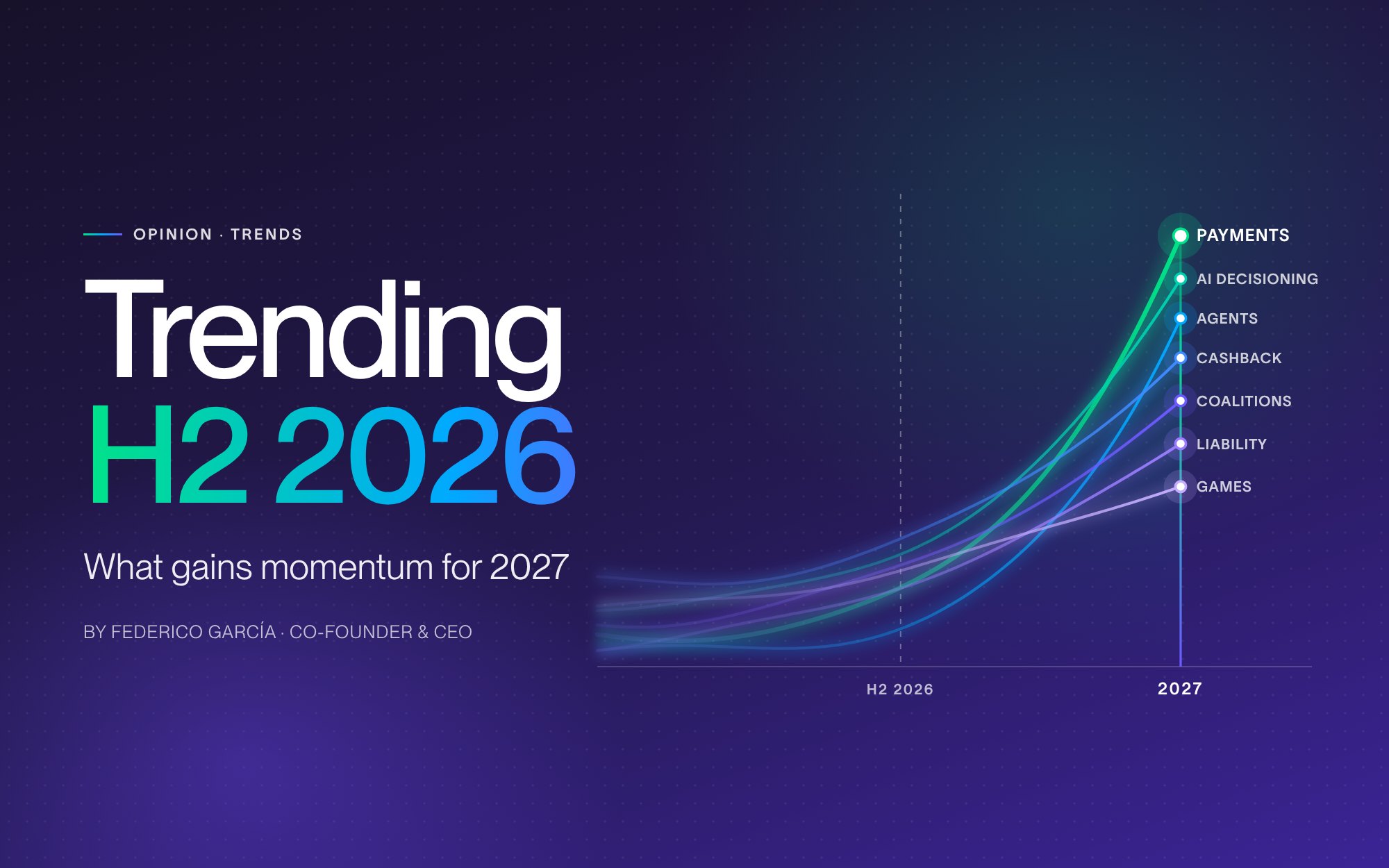
I always say that having the data isn’t enough: you have to use it at the right moment. The seven trends that follow are, at heart, seven ways of getting to that moment.
The benefit arrives at the moment of payment
For years, the program acted after the purchase. Points arrived hours or days later, when the customer had already moved on. Today payment is digital and instant, and customers expect to see the benefit in that same second.
Brazil is the best example: Pix accounted for 54.7% of payment transactions in the second half of 2025, according to Banco Central do Brasil. When paying takes seconds, a benefit that arrives days later loses almost all of its effect.
That’s why at Qurable we decide the benefit within the authorization, in about 150 milliseconds. And there is one rule we don’t negotiate: the program never blocks the sale.
AI chooses the reward and the benefit, customer by customer
Segmenting by large groups falls short. With AI we can choose, for each person, which reward or benefit makes sense based on their history, their ticket and the context of the purchase. It’s moving from audiences to hyper-personalization.
The demand is there: 71% of consumers expect personalized interactions and 76% get frustrated when they don’t get them, according to McKinsey. But there is a condition: more than 75% would not buy from a company they don’t trust to handle their data, according to Cisco’s 2024 privacy survey.
My advice is to embrace AI fast, but on an orderly foundation: a single record per customer and clear consent by channel. At Qurable, decisioning AI chooses the reward or benefit using rules, history and context, and nothing that affects customers goes live without human approval.
AI agents that buy on the customer’s behalf
This is the one that excites me most. AI assistants already search, compare and are starting to pay on people’s behalf. If the agent can’t see your program’s benefits, your customer stops considering them when deciding.
Euromonitor International lists AI agents among the top five loyalty trends of 2026. Payment networks are already moving: Mastercard launched Agent Pay in April 2025 and said merchants will be able to add rewards and discounts for the customer it identifies. In April 2026, Visa introduced a platform that lets agents pay across several card networks.
For 2027, my bet is that a program that can’t be queried and operated through an API will be left out of many purchases. We already offer an MCP server so that connected AI agents operate with the same rules and permissions as the rest of the platform.
Cashback that travels with the payment
The most valued benefit is still tangible savings. That’s why programs tied to cards, wallets and issuers are growing: the reward travels with the payment.
In Latin America, 58.7% of people join a loyalty program to get discounts or offers, according to Euromonitor International. Mastercard reports that co-brand cardholders spend between 3 and 6 times more than non-members. And American Airlines received 6.2 billion dollars from its co-brand card partners and other partners in 2025. The program is no longer a marketing cost: it’s a revenue line.
What I see working is giving cashback at the moment of payment and co-funding it: the bank covers one part and the merchant the other. We run it in production, with a published case alongside Pomelo, and the ledger records each party’s contribution.
Brands that join forces
A standalone program makes the customer wait too long to redeem. When several brands join forces, the path to the first reward gets shorter, and each brand’s data is enriched by the others’.
45.1% of Latin Americans say the main problem is that “it takes too long to earn a reward,” according to Euromonitor International. The same firm expects coalitions to challenge the standalone-program model.
The question is how to add partners without losing control of the cost. SKY Plus, SKY Airline’s program running on Qurable, has more than 70 partnerships and 50,000 daily transactions with partners. Every points exchange between brands is recorded as a single operation in the ledger, at each brand’s rate.
Points are treated like money
Every point issued is a debt to the customer. With budgets under closer watch, finance teams want to know how much is owed, when it expires and how much each campaign cost. And they’re right.
In 2025, 27% of points earned went unused and, in programs with expiration, 12% expired, according to Antavo’s Global Customer Loyalty Report 2026. The same study says 41.1% of customers disappointed with their program mention rewards that expire before they can use them.
We learned this early, when we started booking loyalty program debt as an accounting liability. Today every movement lives in a double-entry ledger, with lot-level traceability, real-time liability by currency, country and store, and an expiration forecast at 30, 60 and 90 days.
Games with a business goal
Points alone no longer create excitement. Games, missions and badges give customers a reason to come back between purchases. But they only work if they’re tied to something the brand cares about.
27% of Gen Z and 25% of millennials describe loyalty programs as “not fun,” according to Euromonitor. The same source notes that a Marriott Bonvoy game mechanic coincided, in May 2025, with a 6.5% increase in its app downloads.
My rule is simple: every game gets a budget and a cap. At Qurable, games, missions, trivia and rules share the same engine, with prizes that have their own probability and a maximum number of attempts per game.
What I take into 2027
All seven trends say the same thing. The loyalty program stops being a marketing channel that acts afterwards and becomes infrastructure that acts at the moment of purchase. It’s about being top of mind with the right touchpoint: the right person, at the right moment, through the right channel.
Today we manage 18 million members across more than 6 markets, with relevant programs across the region. And if I had to leave you three questions for your 2027 plan, they would be these:
- Can your program decide the benefit at the moment of payment?
- Do you know in real time how much it costs you?
- Can your partners and AI agents operate it with the same rules as your team?
If any answer is “not yet,” that’s your priority for next year.
Frequently asked questions
Rewards at the moment of payment, AI that chooses the reward or benefit for each customer, AI agents that buy on the customer’s behalf, cashback tied to the payment method, brand coalitions, control over points liability and games with a business goal.
It means deciding and applying the benefit within the transaction, at the POS, the checkout or the processor, instead of crediting it days later. The customer sees the reward at the same moment they pay.
If an AI agent buys on the customer’s behalf, the program has to expose balance, benefits and rules through an API. If it doesn’t, the agent won’t consider them and the customer stops seeing them when deciding.
Because every point issued is a future obligation. Measuring it in real time, with expirations and cost per campaign, lets you sustain the program with no surprises on the balance sheet.
Real-time payments, such as Pix in Brazil, and the weight of savings: 58.7% of Latin Americans join a program for discounts or offers. That drives cashback, co-brand cards and coalitions.