Starbucks does not grow on points, it grows on decisions
Starbucks Rewards is not the world's largest loyalty program because of its member count. It is because of what it does with them. With 35.6 million active U.S. members at Q2 FY2026 (+4% year over year), the program generates roughly 60% of revenue at company-operated stores in North America, and over USD 13 billion in member spend in fiscal 2025.
The differentiator is not the points mechanic. It is Deep Brew, Starbucks' proprietary AI engine. Deep Brew analyzes individual purchase behavior, visit frequency, personalization history, and context to deliver individualized offers through the app. It does not assign customers to broad segments. It makes a decision for each customer, in real time, at the moment of highest intent: the order.
The lesson is not about product design. It is about business model. Integrating ordering, payment, and engagement into a single architecture is a structural choice. When 60% of revenue runs through a proprietary channel, the brand has built a competitive position no rival can replicate without rebuilding the architecture. McKinsey research on personalization confirms the mechanism: leaders generate 5% to 15% more revenue and improve marketing efficiency by 10% to 30%.
The same principle, without being Starbucks
Starbucks' edge is not the app itself. It is that the app is, at once, the ordering channel, the payment channel, and the engagement channel. That integration removes friction between intent and transaction and gives the decision engine the most complete signal at the moment of highest receptivity.
The same principle applies in LATAM, with or without a proprietary app. Qurable delivers it to QSR, retail, and financial services brands in two configurations: building the full ecosystem (app, ecommerce, loyalty, and payment) or activating the decision engine on top of the POS or PSP, where payment already occurs. In both cases, personalization is one to one and the CDP —the unified customer database— is built on real transaction signal.
The case: MostaClub
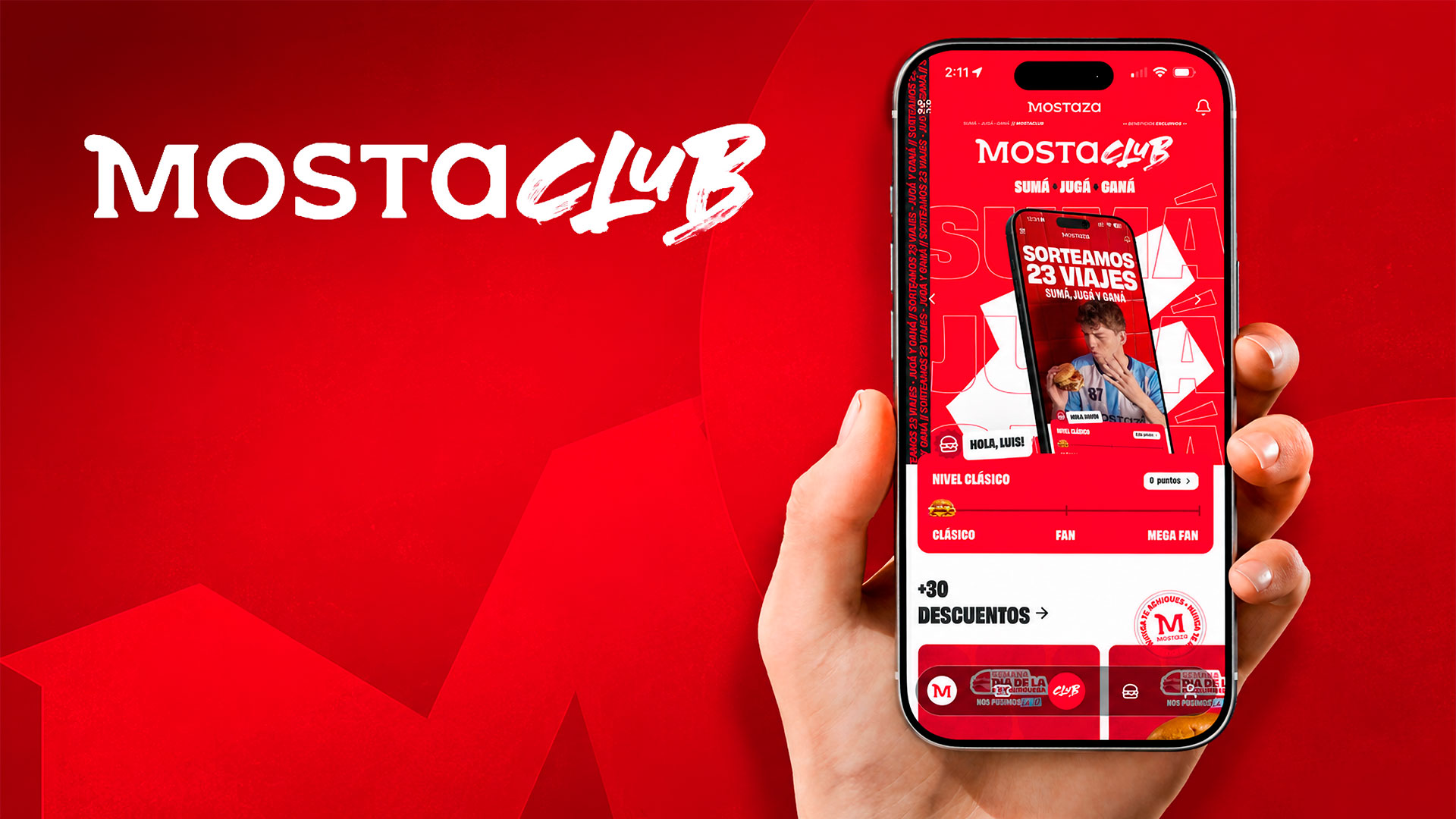
Mostaza, one of the most recognized QSR chains in the Southern Cone, launched MostaClub: a 100% digital hybrid loyalty program that combines benefits, engagement, and gamification, designed for a Gen Z audience. It launched simultaneously in Argentina, Uruguay, and Paraguay, integrated with a new app and ecommerce, with payment inside the experience, aligned to the timing of the World Cup, with more than 30 trips raffled among its users.
In QSR, customers return out of habit or for a promo, not because the brand gives them a structural reason to come back. With outsourced delivery, aggregators keep the data; in-store purchases leave no record; and the brand ends up with volume but no idea who its customer is. Before MostaClub, Mostaza's digital relationship was fragmented: an old, transactional app, no loyalty program, and no visibility into frequency or ticket per customer.
In QSR, the challenge isn't selling once, it's giving the customer a reason to come back, and with outsourced delivery, you often don't know who your customer is. For a brand with a Gen Z audience, a traditional points program isn't enough. That's why we designed MostaClub as a 100% digital hybrid model that combines benefits with engagement and gamification, not as just another points system.
Qurable worked with Mostaza on four integrated fronts under a single team: new app, new ecommerce, loyalty program, and integrated payment. MostaClub was built as an ecosystem, not a standalone points system.
- Three tiers — Clásico, Fan, Mega Fan — with differentiated benefits per segment.
- Points, coupons, missions, and active contests built into the program.
- Exclusive experiences: tickets, trips, merch, and gift cards.
- Unique user identification: earn and redeem at any point in the network.
- Real-time synchronized operations across Argentina, Uruguay, and Paraguay.
Before, outside the app, we had no way of knowing who our customer was: the in-store purchase leaves no record and delivery keeps the data. MostaClub became our CRM, for the first time we have our own database to know, segment, and speak to each customer.
Three factors explain the outcome: the synchronized multi-country operation (AR, UY, PY) launched simultaneously, uncommon for a regional brand; the integrated build under a single team kept the program connected to the purchase flow; and the alignment with the World Cup and youth culture made the program feel native to the brand, not an add-on.
What we valued most was having everything connected in a single ecosystem: app, ecommerce, loyalty program, and integrated payment inside the experience. The customer earns points, redeems, and pays without leaving the flow, and we stopped losing them at the last step of the purchase.
Why it matters
The question for QSR, retail, and financial services leaders in LATAM is not how to build an app like Starbucks. It is how to put decision intelligence at the moment of payment, across any channel. MostaClub is the proof that it can be done, and fast.
With Qurable we built an ecosystem, not an add-on. Having a team that understood the business and supported us end to end let us integrate benefits, tiers, gamification, and experiences into a single platform, and sustain it across three countries at once. They acted as a true partner at every stage.